When a placeholder domain becomes a trap: a real-world example
Domains used for years as harmless placeholders have started serving dangerous and deceptive content. Researchers found similar addresses in hundreds of thousands of GitHub files. For documentation, example.com remains the safer choice.
“Let’s just use some example domain here” sounds like one of the least risky decisions you can make when writing documentation. The problem starts when that example domain is real, somebody can change what it serves, and hundreds of thousands of files still treat it as a harmless placeholder.
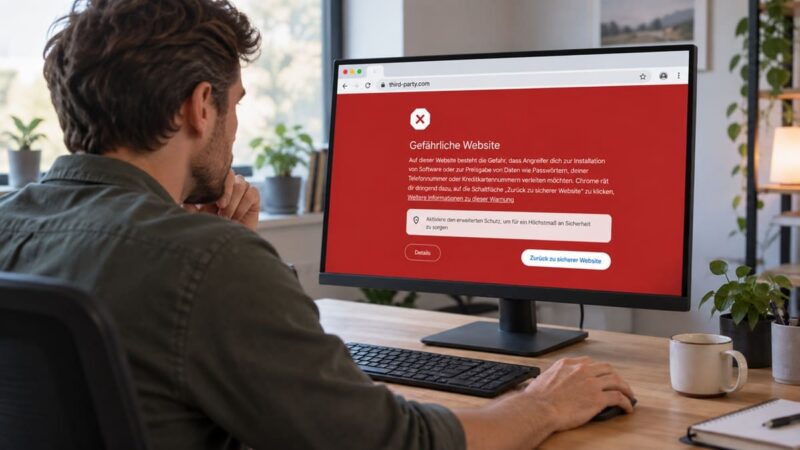
Manifold Security has documented exactly that scenario. The domain third-party.com, used for years in examples and documentation as if it were a neutral placeholder, started showing Windows users a fake verification prompt that led to a social-engineering attack.
The placeholder stopped being a placeholder
According to Manifold, the domain appears in more than 1,500 files across over 1,700 public repositories. The results include documentation, configuration examples, material about MCP servers, and skills for AI agents.
Explore our services.
Simply mentioning the address in documentation does not compromise a computer. The risk appears when a person, an application, or an automated tool takes the example literally and actually opens the domain.
The site also changed its behaviour depending on the visitor’s environment, making the problem harder to catch with simple automated checks.
A day later, it got even more interesting
On 24 September, Manifold published a follow-up. The team examined more domains being used as example addresses even though they are not reserved for that purpose by IANA. Two of them – yoursite.com and your-domain.com – sent some visitors to ads and scams, while appearing to others as ordinary parked domains.
According to the researchers, the two addresses appear in more than 350,000 GitHub files combined and in hundreds of agent skills. Static checks missed the problem because the redirect was only triggered after the page’s code had executed.
This is exactly why example.com exists
IANA maintains domains reserved specifically for documentation, including example.com, example.org, and example.net. They cannot simply be registered or transferred to a new owner. That means an example URL added to documentation today should not suddenly point to a random shop, a scam, or somebody else’s server a few years from now. Local-looking alternatives are used in different markets, but they do not automatically have the same status. beispiel.de is a good example. The site currently says the domain was created for use in documentation, but its footer also says the domain is for sale. In theory, somebody could therefore buy a domain that is itself widely used in documentation and as a placeholder.
It sounds like a tiny detail, but it matters anywhere examples are copied without much thought: API documentation, configuration guides, README files, tutorials, prompts for agents, webhook configurations, and integration examples.
What should you check in your own documentation?
- whether example URLs use domains that are actually reserved for documentation,
- whether old instructions still contain real domains that once belonged to a provider or client,
- whether automated tests and agents literally open addresses copied from documentation,
- whether sample webhook URLs, callback URLs, and endpoints point to domains that somebody can register.
WebsiteGarage’s take
This is a great example of a problem that looks ridiculous right up until it stops being funny. Somebody types “third-party.com” because it sounds generic enough for an example. Then the example takes on a life of its own, spreading through documentation, repositories, and data consumed by AI tools. The domain, meanwhile, is still an ordinary domain controlled by a real person or organisation.
AI agents give this old problem another dimension because the example no longer has to wait for a human to click it. A system can read the instructions itself and try to contact an address that looks like part of the procedure. I have also come across public websites where a sample domain was accidentally left in place and was genuinely clickable. If that link later points to a scam, the consequences can be considerably more serious.
Discover more articles
- WPML, used on more than 1.5 million sites, had an SQL injection flaw. A Subscriber account was enough
- Claude reached the open internet during testing. Anthropic reveals a fourth incident and reviews 481 million transcripts
- 395 organizations, 440 PaperCut instances and hundreds of AI agents: the attack shows a new scale of automation
- How NOT to commission a website
- WooCommerce explains how to prepare your store for AI agents. The problem? Your product catalog.
- WordPress maintenance: what a professional service should actually include
- Cloudflare is bringing order to AI bots. Website owners can more easily see who reads their content and why
- WordPress slow? Why nothing happens for several seconds
- AI used your content? Cloudflare wants you to get paid