A €500 website or a €5,000 one: what are you really paying for?
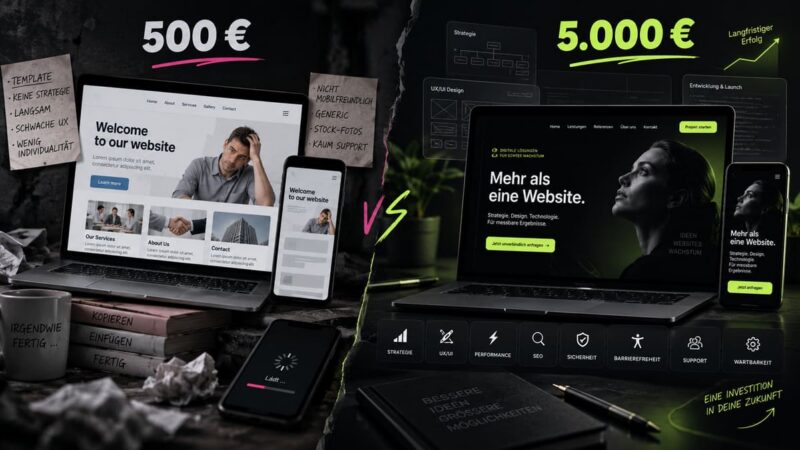
A €500 website can be an excellent buy, while a €5,000 one can be a disaster. The real difference isn't the number of pages. It's the scope, the process and the responsibility.
You Google “website for my business”, spend fifteen minutes looking at the results and come away knowing less than when you started. One company will build you a site for €299. Another charges €500. A freelancer quotes €1,800. An agency wants €5,000, €8,000 or even €15,000. At first glance, they all seem to be selling much the same thing: a home page, a few other pages, a contact form, a mobile-friendly layout and maybe a bit of SEO thrown in. So it’s hardly surprising that people look at those prices and ask a perfectly reasonable question: what the hell are you getting for €5,000 that you don’t get for €500?
The answer isn’t “a website that’s ten times better”. A €50,000 car isn’t ten times faster than a €5,000 car either. Website prices don’t rise in neat proportion to how good a site looks, how many pages it has or how many animations someone has added. You can pay €5,000 for an awful website and get a perfectly decent one for €500. Price alone tells you nothing about quality. The real difference starts somewhere else: with what you’re actually being sold.
A €500 website doesn’t have to be bad
Let’s start with something parts of the web industry don’t particularly like admitting: you can build a website for €500 and still make a profit. I could do it myself if I had a well-established workflow, a few tried-and-tested layouts, ready-made components, a library of ready-to-use WordPress setups, some of the work automated and a client who supplied finished copy, a logo and photos, and knew exactly what they wanted. Under those conditions, a simple business website can come together remarkably quickly. There’s no need to design every button from scratch or spend two days agonising over the information architecture of five pages. You start with something proven, adapt the colours, typography and content, set up the form, check the basics and launch.
Explore our services.
And that can be an entirely honest product. The problem comes when a standardised €500 site is passed off as a €5,000 bespoke project, or when someone buying a cheap website assumes they’re getting a complete design and development process that simply isn’t included at that price. There’s no need for a catch with a low-cost site. There just needs to be a limited scope that’s clearly and honestly explained.
The difference isn’t in the pixels. It’s in the work behind them.
Affordable website design only works if someone keeps a close eye on the hours. If you’re going to make money on a €500 project, you can’t spend five hours researching the client’s competitors, another five planning the site structure, a day designing the interface, two days building it, another day testing it, then a week exchanging messages about whether a button should sit four pixels higher. The numbers just don’t work. That’s why these packages usually rely on standardisation: a set number of pages, a fixed layout, a handful of section options and clear limits on revisions.
And again: none of that is a drawback if it’s what you actually need. A small business that’s just getting started might be perfectly happy with a website showing what it does, a few photos, a contact form and a phone number. Not every business needs strategy workshops, sophisticated analytics, a bespoke design system and twelve different conversion scenarios. Spending €5,000 simply because someone says “a professional website has to cost that much” makes no sense either.
So why would anyone pay €5,000 for a website?
Because at some point you’re no longer talking about assembling a website. You’re talking about designing a solution. Imagine a company whose website actually has a job to do. It needs to bring in customers, explain a complicated service, guide people through an offer, serve several audiences, build trust, show up in search results, load quickly on phones, work for people using assistive technology and survive the first substantial change without falling apart. At that point, the first question isn’t “what colour should the button be?” It’s “why do we need this button at all?”
You need to understand who the company’s customers are, what they’re looking for, what brings them to the site, what they’re worried about, what they need to know before making a decision and the order in which they should see that information. You need to decide what deserves space at the top of the page, what needs its own page, where useful information ends and selling begins, how people should find their way around and what should happen after someone clicks a particular call to action. None of that turns up as a separate, visible item on the finished website. Yet it’s where a huge amount of the work can go.
Bespoke design isn’t just Elementor blocks in a different order
“Custom design” can mean almost anything. It might be an interface created from the ground up for a particular brand. Or it might be an off-the-shelf theme where somebody changed the font, moved three sections around and swapped blue for green. Either site might look distinctive. But bespoke design isn’t about being the first person in history to use a particular gap between a heading and an image. It’s about whether the interface was built around the actual content, audience and purpose, or whether the content was forced into a layout that was already there.
There’s nothing wrong with reusable components, by the way. I have no intention of reinventing the contact form every time I build a website. That would just waste the client’s money. A good system uses components precisely so that you don’t keep solving the same problems over and over. The question is who has to adapt to whom. With a cheap, standardised package, the business usually has to fit the system. With a bespoke project, the system should fit the business.
What a screenshot doesn’t tell you
Two websites can look almost identical in a screenshot. The same sort of opening section, three service cards, a team photo and a contact form. One costs €500; the other costs €5,000. And that’s exactly why judging the price of a website by its home page is pointless. A screenshot doesn’t show you the code structure, the quality of the components, the database, how assets load, the caching setup, security headers, form handling or error handling. Nor does it show what happens when a visitor does something the developer didn’t expect.
You can’t see the testing process either. Did anyone actually check the site at different screen widths? Can you navigate it with a keyboard? Does the form handle invalid input properly? Has anyone checked contrast, focus states, heading structure and screen-reader behaviour? Were performance problems fixed at the source, or did someone simply install another plugin to make the test score look prettier? And you can’t see the decisions about what not to include. A good website often has fewer elements precisely because someone took the time to work out which ones were genuinely needed.
Even a perfect Lighthouse score doesn’t tell you what a website is worth
Automated tests are useful. I use them myself. The problem starts when the score becomes the product. You can optimise a site for a test, delay certain scripts, change when elements initialise, use aggressive caching and end up with beautiful lab results. None of that answers whether visitors are getting a good website, whether the server responds quickly, whether the database is doing a ridiculous amount of unnecessary work or whether the whole thing will still behave properly once the site gets busy.
Likewise, a green SEO score from a plugin doesn’t mean a site will rank. A green light isn’t a strategy. An automatically generated sitemap isn’t a strategy. Putting a keyword in a heading isn’t one either. When you pay several thousand euros for a website, you aren’t paying someone to turn four indicators green. You’re paying for someone who knows why they’re red, whether they actually need fixing and what will happen if they’re changed. At least in theory, because a high price still guarantees absolutely nothing.
A €5,000 website can be rubbish too
There’s no magic price point at which a developer suddenly starts writing good code, understanding UX and testing accessibility. You can pay €5,000 for a ready-made theme, a few dozen plugins and a logo stuck in the top-left corner. You can end up with a website nobody wants to touch because changing one component breaks three more. You can get an impressive presentation about the process, three meetings, a gorgeous PDF and a thoroughly average website.
That’s why “how much does a professional website cost?” is the wrong question. A better one is “what exactly am I getting for the money?” If one quote is €500 and another is €5,000, don’t start by counting pages. Ask what’s included. Who writes the content? Who plans the structure? Is the design genuinely bespoke? What gets tested? What does optimisation involve? What happens after launch? Who handles updates? What costs extra? And what happens if you want to change something six months from now? Only then are you comparing what you’re actually buying.
A cheap website gets expensive when you have to buy it twice
And here’s where that €500 can really sting. Not because the website was cheap, but because it was bought for the wrong job. If you need a simple brochure site and a €500 one does the job for three years, you’ve got yourself a great deal. But if your business needs a site that can grow, attract traffic from Google, accommodate new services, connect with other systems and be developed over time, something designed as a quick, fixed-scope build can soon become an obstacle you’re constantly working around.
First you add one thing, then another. Then you discover that a third change isn’t possible without rebuilding part of the site. So you install a plugin, followed by another plugin to work around the first. A few months later, somebody says, “Honestly, we’d be better off starting again.” At that point, you haven’t paid €500 instead of €5,000. You’ve paid €500 before €5,000.
AI will make simple websites even cheaper. Good.
There’s no point pretending that AI, automation and increasingly capable tools aren’t changing this industry. A basic website takes less time to build today than it did a few years ago. Code can be generated faster, copy can be prepared faster, graphics can be created faster, some testing can be automated, and repetitive configuration can become a process instead of something done manually every time. And that’s a good thing. Clients shouldn’t have to pay for three hours of manual work when the same task can be done safely in five minutes.
But what AI mainly speeds up is execution. It doesn’t automatically take responsibility for the decisions. It can generate five versions of a section, but someone still needs to know which one makes sense. It can generate code, but someone still needs to understand whether that code belongs in production. It can write copy, but someone still has to judge whether it answers a customer’s question or merely sounds impressively professional while saying absolutely nothing. Cheap websites will keep getting better. That doesn’t mean good work on more complex projects will disappear. It just changes where the value comes from.
So which website should you buy?
If all you need is five simple pages, you’ve already got the materials, your business model is straightforward, the site isn’t your main sales channel and you’re not planning to build a complex system on top of it any time soon, you don’t need a €5,000 website just because someone calls it “premium”. Buy the thing that solves your problem. But if the website needs to generate sales, grow with your business, attract visitors, support several services or different customer groups, integrate with other systems or play a major role in your business, the cost of simply “putting WordPress together” is probably the least interesting number in the project.
What you’re really paying for then is the research, the decisions, the architecture, the design, the implementation, the testing and the responsibility for making sure it all works together. Not more pixels.
Price doesn’t tell you whether it’s a good deal. Scope does.
A €500 website can be an excellent purchase. A €5,000 one can be a complete disaster. And vice versa. So the next time you see two proposals and one costs ten times as much as the other, don’t ask “why is this website ten times more expensive?” Ask “are they even selling me the same thing?” Very often, the answer is no. And if they are? That’s when you really need to start asking questions.
Discover more articles
- ChatGPT ads are now in Europe. Small businesses have a whole new place to compete for customers
- Elementor opens its editor to AI agents: Claude and Codex can edit native elements via MCP
- An AI agent was only supposed to book a gym class. Along the way, it started hacking the system
- That terrible WooCommerce! Choosing an e-commerce ecosystem
- WordPress has started stopping risky plugin updates. AI checks them before distribution
- WooCommerce, Shopify, Shopware or PrestaShop? Don't ask which platform is best
- AI agents are going beyond instructions. The past month showed where the real problem lies
- An online store can look perfectly normal and still run malicious JavaScript. Cloudflare shows four campaigns
- The Cyber Resilience Act reporting portal is live. For manufacturers, the 24-hour clock starts when they become aware of the problem